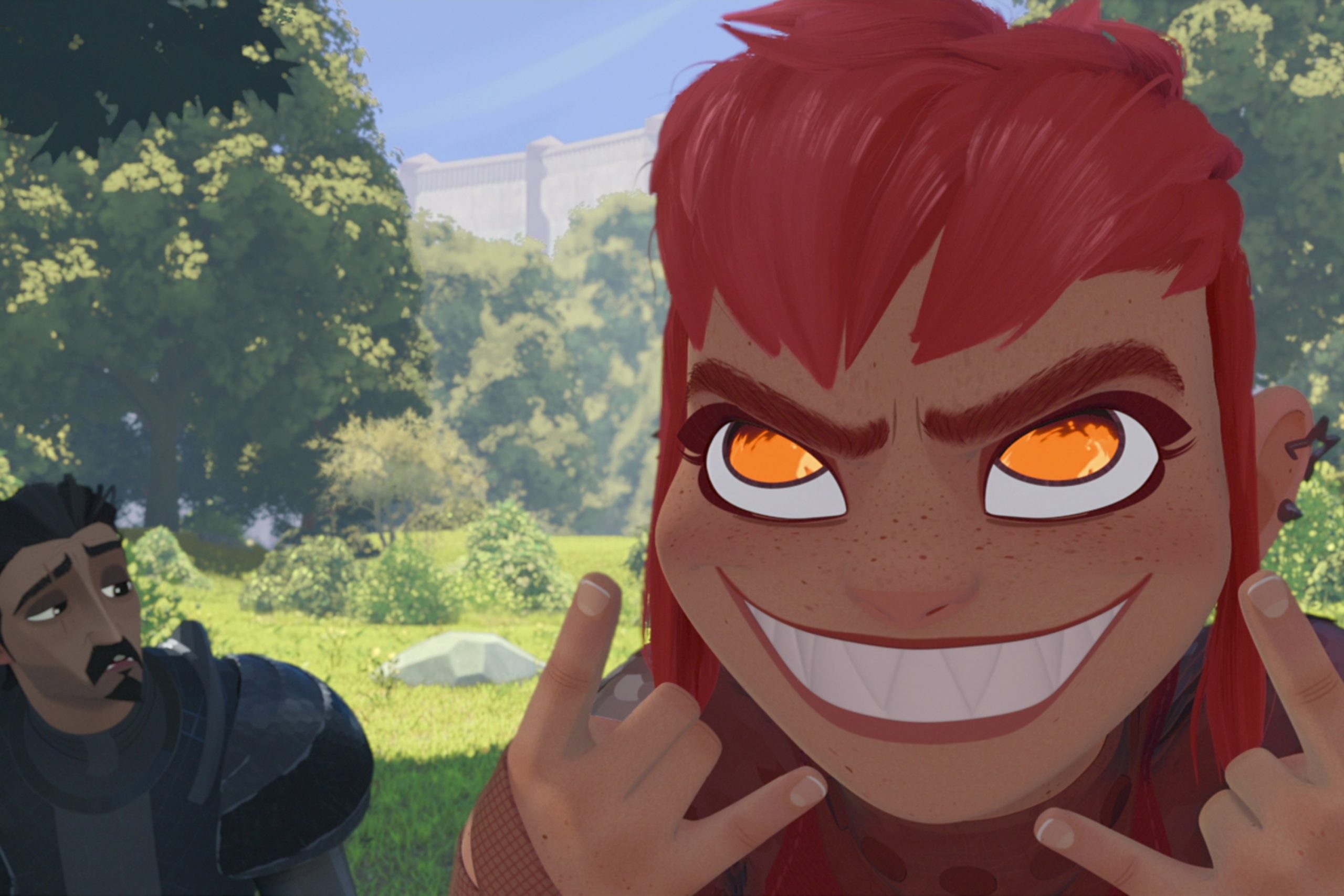
2024, written by Alex Bregy. An exploration of gender identity and expression; limiting schemas, and the fear of otherness through the lens of Nimona (2023).
Nimona as a Gender-Fluid Icon:
Why Trans* People Can’t Win
At first glance, Nimona is the epitome of the female grotesque. In her most common form, she appears as a spunky teenage girl who aims to cause chaos above all else. She is violent, brass, and combative towards authority—unwilling to listen to someone simply because she’s told to do so. Though, upon further examination, it is clear that Nimona’s performance of gender is not quite in line with the binary. Her ill-received common form is the form she takes to make others comfortable. Beyond this, she contains many different forms that, when not pressured by society, she enjoys shifting through fluidly, as feels natural to her. So, through her fluid identity, Nimona represents otherness—notably transness—and her inability to assimilate into society typifies the inability for trans* people to be fully accepted within heteronormative society. Additionally, Nimona’s relationships with Gloreth and Ballister demonstrate bigotry as a learned behavior and that individual schemas can be shifted in order to be more inclusive.
Context from the Film
Nimona, a 2023 film directed by Nick Bruno and Troy Quane, follows the two protagonists, Nimona and Ballister, as they make a place for themselves in a society that is built against them. Their society, known as The Kingdom, worships Gloreth, a knight who slayed a “Great Black Monster” (Troy and Quane) and enclosed her society within high concrete walls to protect them. Because of this, The Kingdom is protected by The Institute of Elite Knights, which is ruled by The Queen. The Institute is founded on the ideology of Gloreth; that is, the eradication of anything different. All members of The Institute descend from royal families, mostly other Elite Knights, and some even descending from Gloreth herself. This is, aside from Ballister.
Ballister is the villain of The Kingdom. When Ballister was a child, he broke into the yard of The Institute’s training facility and demanded training. Being a commoner, The Queen made an exception to their normal rules about a royal bloodline and allowed for Ballister to study with The Institute and become an Elite Knight. Then, during his knighting ceremony, he was framed for murdering The Queen because his sword was switched with one that had a hidden missile, which killed The Queen. During this, his lover—Ambrosis, a descendant of Gloreth—shot the gun in order to disarm Ballister; though, in the process, Ballister lost his arm. After this terrible event, Ballister became the most wanted person in The Kingdom, so he hid in an abandoned building, which became his home. While he finishes building his prosthetic arm, Nimona appears, requesting to be his evil sidekick.
At first, Ballister doesn’t identify as a villain. Instead, he is determined to prove that he was framed, but, Nimona, who has experienced centuries of bigotry and hate, has different plans. She wants to take down The Institute and inflict them with the pain they have caused both her and Ballister. Together, Nimona and Ballister uncover the details of Ballister’s framing, discover the secret evils of The Institute, and work to build a more inclusive society.
Nimona’s Gender Fluidity
Nimona experiences gender fluidly. Throughout the film, Nimona shifts into many different forms, some being humanoid and many being animalistic or even fantastical. When Ballister asks Nimona, “What are you?” she replies with, “I’m Nimona.” Ballister then notes, “That’s not an answer. People don’t just turn into things” and Nimona says, “I do” (Troy and Quane). This exchange elaborates upon Nimona’s experience with fluid identity, and in turn, fluid gender. In fact, when Nimona is questioned about her gender, she never places herself within the binary. At one point, when Nimona shape-shifts, Ballister says, “And now you’re a boy,” to which Nimona replies, “I am today” (Troy and Quane). Here, we can see that, even when she presents as a binary gender, Nimona does not label herself with that gender identity permanently; thus, she showcases her gender fluidity.
Ballister’s Initial Reaction to Nimona’s Gender Fluidity
Nimona’s identity falls outside of Ballister’s gender schema, causing him to question and hence rationalize her existence in a way that makes sense to his personal gender schema. At one point, Ballister asks, “Can you please just be normal for a second?” to which Nimona replies, “Normal?” Following this, Ballister elaborates: “I just think it’d be easier if you were a girl,” and Nimona responds, “Easier to be a girl? You’re hilarious.” Ballister then notes, “I mean, easier if you looked human,” and Nimona counters, “Easier for who?” to which Ballister says, “For you. A lot of people aren’t as accepting as me” (Troy and Quane). Here, we can see that Ballister is trying to make sense of Nimona’s fluid gender identity. Until now, he has never met anyone with a fluid identity, so it is not currently in his gender schema. He asks Nimona to stay in her “girl” or “human” form so that she can fit within his gender schema. The use of the “human” form is interesting because it refers to a form in which this society would perceive as normal, or not “other.” Because of this, I feel that the request for a “human” form parallels real-life requests for trans* people to fall into the gender binary. Thus, Ballister asks for Nimona to fall into the gender binary since he can understand her identity if it is within the gender binary. Additionally, the mainstream views on gender in their society are even more limited than Ballister’s, so he believes that forcing Nimona into the binary will keep her safe. Ballister does not know much, if anything, about transness, so he doesn’t understand that forcing Nimona into the gender binary is actually harmful to her.
Ballister Growing his Schema
Over time, Ballister begins to understand Nimona’s identity and his gender schema grows. After Ballister and Nimona have grown closer, Ballister asks, “What does it feel like…the shape-shifting. Does it hurt, or?” and she replies: “I feel worse when I don’t do it. Like my insides are itchy…then I shape-shift, and I’m free” (Troy and Quane). This quote shows that Ballister is actively trying to grow his gender schema to fit Nimona’s identity within it. Instead of asking her to change her identity, he is asking questions about it to better understand. Since fluid identity is not something that Ballister experiences, his initial reaction was to shut it down and make Nimona behave in a way that he could understand. This is a common reaction for many real-life people. Now, Ballister wants to understand Nimona rather than change her. Furthering this, he asks, “What if you…didn’t shape-shift?” and Nimona remarks, “I’d die…I wouldn’t die-die, I just sure wouldn’t be living” (Troy and Quane). Here, we can see that Ballister is trying to further understand Nimona’s identity and how it differs from his. In this way, Nimona describes her need for fluidity within her gender identity—she is uncomfortable, or even in pain, when she represses the fluidity of her identity. This explanation parallels the experience of gender dysphoria within trans* people.
Gender dysphoria is defined as, “a sense of unease that a person may have because of a mismatch between their biological sex and their gender identity” (2020). This unease often leads trans* people to transition, whether that be medically or socially, to feel more aligned with their gender identity. For people with gender fluidity, many aspects of social transition can be undergone/shifted regularly to correspond with their shifting identity. In other words, these aspects of social transition (ex. pronouns, clothing, etc.) can change with the person’s changes in gender identity; thus, transitioning can allow them to feel aligned with the gender that they are currently identifying with. Otherwise, many people with fluid gender identity would experience gender dysphoria, which causes psychological distress. If you were to ask a trans* person how they would feel if they had to live as the gender they were assigned at birth, many would have a similar reaction to Nimona—they wouldn’t die, but they sure wouldn’t be living.
Other people’s underdeveloped gender schemas regularly affect the lives of trans* people. Many trans* people will be asked questions like, “What’s in your pants?” or, “What were you born as?” These questions are cis peoples’ attempt to fit trans* gender identities into their current, underdeveloped gender schemas. Yet, these questions are harmful to trans* people, many of which are trying to assimilate into heteronormative society the best that they can. Instead of asking these invasive questions in order to assign trans* people a gender label that makes sense to one’s personal gender schema, they should be trying to understand the trans* person’s identity and how they can respect/support the trans* person. As Ballister and trans* allies demonstrate, it is simple to grow your gender schema by learning about new gender identities. Additionally, as with any person in your life, it is important to know how to give others the respect and support that they deserve.
Gender schemas are a cultural by-product, as most schemas are. In their essay What Does It Cost to Tell the Truth?, Riki Anne Wilchins discusses the perception of human bodies and how it relates to trans* bodies. They note:
Characteristics of mine that are truly innate…ought to be totally apparent to you whether you’d ever seen another human being or not…Any other readings of my body are culturally relative, contingent upon the context in which you locate me. (Wilchins 549)
This quote highlights the fact that, inherently, bodies aren’t looked at with judgment. Anything innate about the body would simply be observed, like the fact that someone is taller than another person—it would just be a fact. On the other hand, as Wilchins mentions, seeing height as good/bad or gendered (ex. “tall for a girl”) is not innate and therefore not something inherently true about a person’s body. So, Nimona’s fluid body and therefore fluid identity, is only seen as being strange, or as “other,” because of the cultural context within which she is perceived and the biases that come with it.
Otherness
Nimona is seen as an “other” and consequently feared. In the fourth thesis of Jeffrey Jerome Cohen’s essay Monster Culture, Cohen explains: “in its function as…Other…the monster is an incorporation of the Outside, the Beyond…but originate[s] Within” (46–47). In other words, the monster is different from the dominant culture in some way, but shares certain traits with them. For Nimona, while her identity is fluid and she challenges authority, unlike most in The Kingdom, she also has many similarities to the dominant culture, such as emotional pain and a desire for connection. Since Nimona shares certain traits with the dominant culture, she can assimilate somewhat, which makes the society even more scared of her. Notably, they are scared that she can “hide” within them; however, she simply exists within them. This is similar to how a lot of trans* people feel about navigating heteronormative culture. Many people hate them, or fear them, just for their gender identity, and it can be dangerous just to exist as a trans* person in a heteronormative society. For Nimona, this is showcased through society’s unwillingness to try to understand her.
It Starts Early
Near the end of the film, it is revealed that Nimona not only knew Gloreth as a child, but is also the monster she supposedly slayed. In a flashback to over one thousand years ago, we see Nimona trying to fit in with the beings around her. She shifts into a deer, a bird, and a fish, and tries to join groups of these creatures, but they all run away from her. Then, when she sees young Gloreth, she shifts into the form of a young girl and watches her from afar. Gloreth notices Nimona and asks her to play. From here, Nimona and Gloreth become good friends, jumping across rocks, napping in the forest, and pretend sword fighting. When Gloreth can’t reach an apple on a tree, Nimona shifts into a bird, grabs the apple, and shifts back into their young girl form. Gloreth is put off by this at first, backing away. Then, she takes Nimona’s hands and smiles. From here, the pair enjoy Nimona’s powers together, Gloreth riding Nimona in horse form and howling at the moon with her in wolf form. But, their fun ends when they stumble into town while Nimona is in bear form.
At first, the citizens of Gloreth’s town are scared of the bear. Then, when Nimona shifts into her young girl form to make them more comfortable, they grow even more scared. Gloreth, who has been pulled away by two adults, shouts, “Stop, she’s my friend!” to which one of the adults replies, “She’s a monster” (Troy and Quane). Following this, many adults begin to attack Nimona, still in young girl form, with various weapons, including pitchforks and torches.
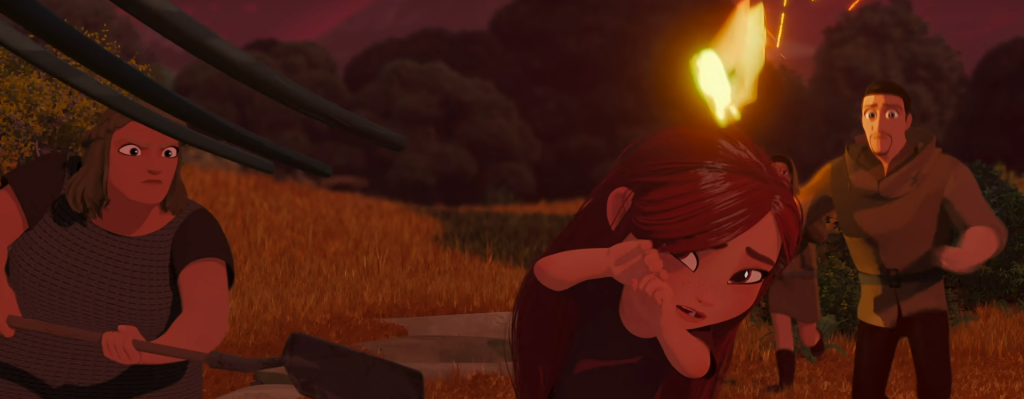
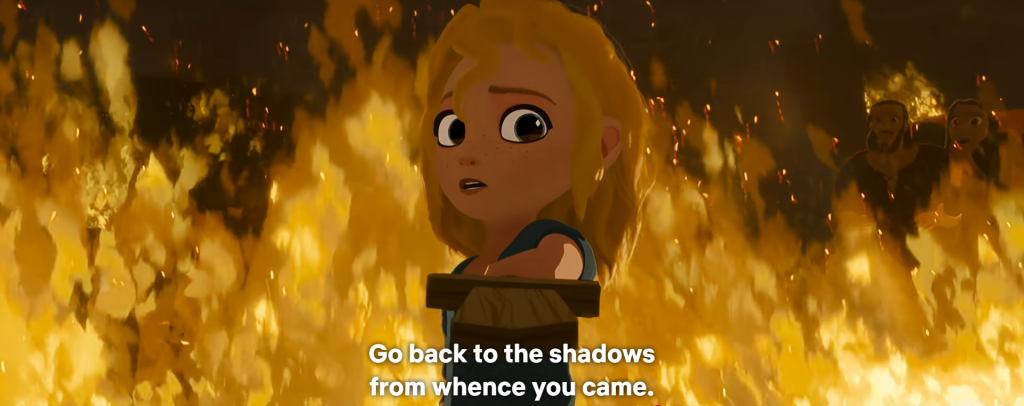
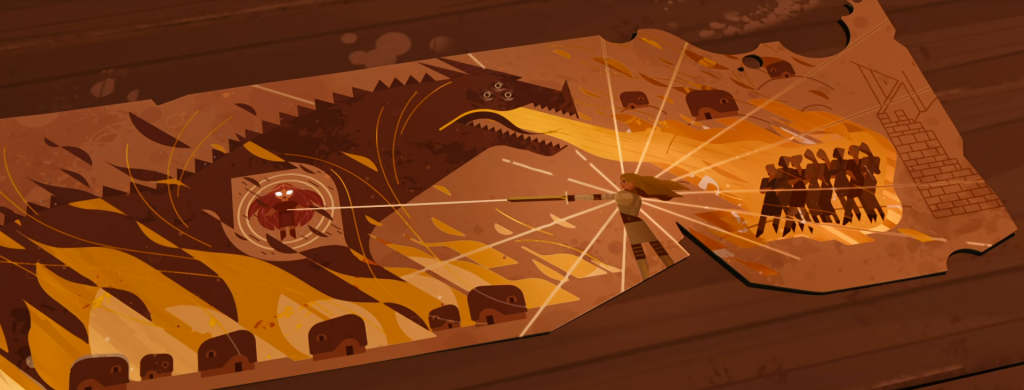
To protect herself, Nimona shifts into different forms and dodges the weapons. When she is in bear form, a woman throws a torch at her back, which burns her and then bounces off and falls onto a wooden fixture that catches on fire. The fire grows and the adults flee. Once they have stopped attacking her, Nimona shifts back into her young girl form. When she notices Gloreth, she tries to explain herself; but, her speech is met with Gloreth holding up her sword and demanding: “Go back to the shadows from whence you came” (Troy and Quane). This statement is referenced with reverence for Gloreth, and The Kingdom, earlier in the film. Additionally, the pose that Gloreth takes when holding her sword up to Nimona is illustrated in the statue center-piece of The Kingdom and a sacred scroll, which showcases her slaughter of Nimona.
Fear of Otherness in The Kingdom
Since The Kingdom is built from Gloreth’s legend and ideology, it is inherently built on the fear of otherness. This is showcased through the strict class divides—royal bloodlines ruling The Kingdom and commoners being seen as incapable—and the absolute disconnection from the outside world via the large concrete walls that enclose The Kingdom. Even so, The Director acts as the strongest example of this phenomenon.
After The Queen is murdered, The Director becomes the ruler of The Institute, and in turn, of The Kingdom. During the climax of the film, it is revealed that The Director is the one who switched out Ballister’s sword for one with a missile attached; put starkly, The Director is the one who murdered The Queen. This decision was driven by her fear of difference. The Director believed strictly in Gloreth’s ideology—she believed that if The Kingdom were to go against this ideology, even in the slightest way, it would crumble. So, when Ballister—a commoner—was going to be knighted, she felt accountable to stop it. Since The Queen believed in Ballister, and was the only barrier of her becoming ruler of The Kingdom, she decided to kill her. Additionally, framing Ballister for the murder of The Queen would ensure The Kingdom’s hatred of him. Thus, her extremely harmful actions were justified by protecting The Kingdom from otherness, which she feared above all else.
This fear leads The Director to act against The Kingdom’s best interest. During the final battle of the film, The Director urges the use of their most powerful weapon. Ambrosis—the head Elite Knight—challenges this decision, stating, “But firing them will take out half the city. Innocent people will die,” to which The Director responds, “And so will the monster” (Troy and Quane). This interaction displays The Director’s willingness to hurt the people she is meant to protect in order to eradicate otherness. She is not afraid of Nimona because of her threat to the people of The Kingdom; instead, she is afraid of Nimona because of her threat to the identities and ideologies of The Kingdom as an institution.
Why Trans* People Can’t Win
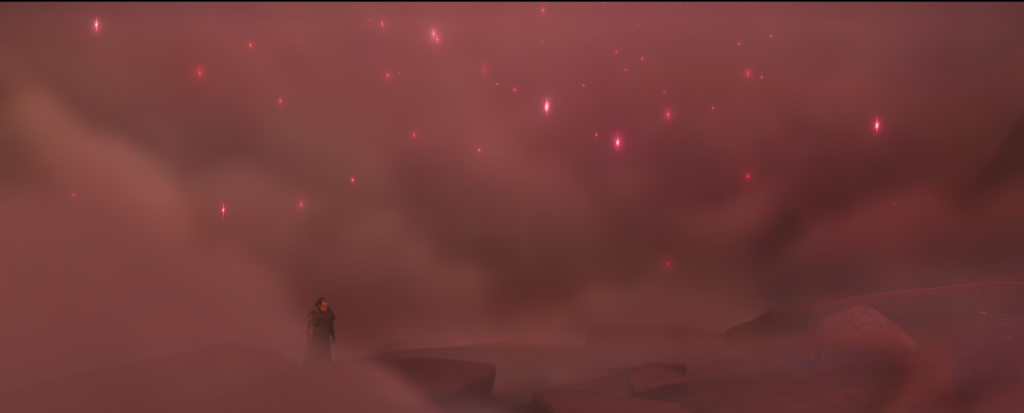
While trans* people can be honored, they can never truly thrive within heteronormative society. Near the end of the film, Nimona blocks the powerful weapon—launched by The Director—to save everyone within The Kingdom. From the explosion, Nimona breaks into a large cloud of dust and tiny, shining diamonds. As Ballister tries to catch the diamonds, they stop glowing and fade away. Because of this, it is assumed that Nimona is dead.
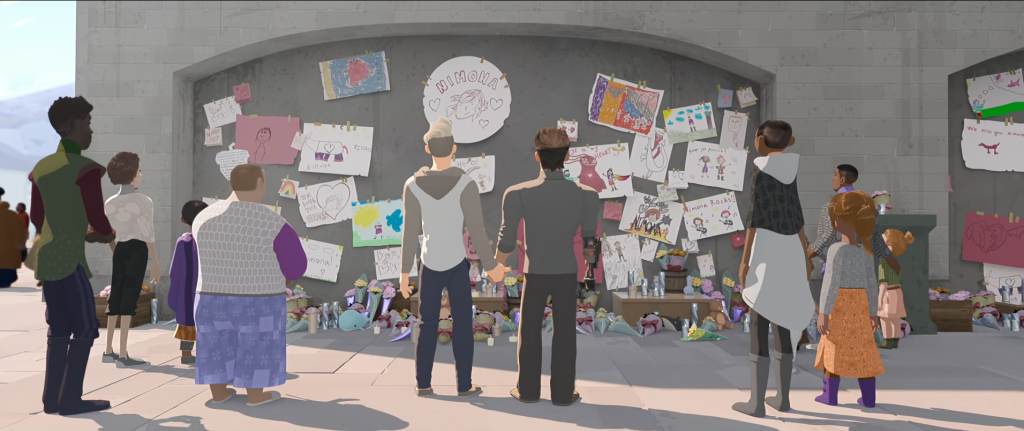
Since she saved the lives of the entire society, she is celebrated and mourned through vigils, including gifts and drawings from children. This is particularly interesting because the people within The Kingdom were harsh to her when she was alive and only celebrate her now that they believe she is dead. Though most of the people within this society did not directly hunt or abuse Nimona, they didn’t support her or stop the abuse from happening. So, via complicity, they have indirectly allowed the abuse to occur. It is not until after she has left their society, via death, that they respect her.
When Nimona does return, she doesn’t integrate into society. In the final scene of the film, Nimona teleports into Ballister’s home and Ballister shrieks with excitement. During this scene, we are visually focused on Ballister and do not see Nimona; instead, we just hear her voice. This being the final scene of the film is striking because it shows that Nimona did not die, yet, she never returned to society. Moreover, she knows that she will never be accepted into society, even if they honor her now—they only respect her when she’s gone. So, she returns to Ballister, who she feels safe with, but does not attempt to assimilate into society.
This parallels queer, and particularly trans*, people’s tendency to make safe spaces for themselves and only enter heteronormative society when it is necessary (i.e., to gather necessities, work, etc.). Typically, queer people band together in found families and spend their lives that way—keeping to themselves and trying their best to stay away from trouble. Thus, having Nimona not reenter society, even though they have found respect for her, illustrates the inability for trans* people to fully assimilate into heteronormative culture. In other words, this shows that trans* people can’t win. If they try to assimilate, they are hunted down and abused; if they don’t try to assimilate, they face the same horrors that they are told wouldn’t happen if they assimilated.
Closing Thoughts
Nimona, through her fluid identity, represents otherness—notably transness—and how it is impossible for trans* people to fully assimilate into heteronormative society. Due to her fluid experience of gender, Nimona shares many struggles with trans* people, including: dysphoria, bigotry, and villainization. Furthering this, her trans* characteristics label her as an “other” and lead her to be feared by society. It is not until she dies that society begins to respect her—it is not until then that society believes that she is not evil, like she has been trying to tell them the entire time.
Nimona’s relationships with Gloreth and Ballister demonstrate bigotry as a learned behavior and the flexibility of schemas. Gloreth did not fear or hate Nimona until trusted adults told her that Nimona was a monster. Inherently, Gloreth did not see Nimona as evil because she is not evil. It wasn’t until the adults assigned the bigoted views from their culture onto Nimona’s traits, that Gloreth found her otherness to be frightening or bad. In this way, Ballister—who grew up worshiping Gloreth’s betrayal of Nimona—initially viewed Nimona’s otherness as frightening and bad because his gender schema was developed by his cultural context. Yet, after getting to know Nimona and asking relevant questions to help him understand her identity, Ballister is able to grow his gender schema to include Nimona’s identity, thus, viewing her otherness neutrally.
Overall, Nimona includes amazing depictions of transness, including how heteronormative society views trans* people and the hardships that come from those viewpoints (bigotry, etc.). As a family film, the demonstration of bigotry as a learned behavior creates an entry point for young viewers to understand their ability to form their own opinions on the people around them. By sympathizing with Nimona, children are able to understand how bigotry hurts those who are different from them; in turn, this understanding averts children from acting bigoted towards their peers. From this, othered—and especially queer/trans*—youth will find it easier to navigate heteronormative culture within their peer groups.
The general audience should be able to pull this message from the film as well, but older audience members may also be able to understand the messages regarding systems of oppression. Generally, this film provides the general public with an evocative display of otherness/transness and how bigotry affects them on a daily basis. With this information, viewers can reflect on their own schemas and think about how they may need to grow. In addition, viewers can dissect their culture—including its systems of power—with a critical lens, figuring out how the system may oppress othered groups and learning how they can change it.
Works Cited
Cohen, Jeffrey Jerome. “Monster Culture (Seven Theses)” Monster Theory: Reading Culture, University of Minnesota Press, 1996, 43-54.
“Overview – Gender Dysphoria.” NHS Choices, NHS, 28 May 2020, www.nhs.uk/conditions/gender-dysphoria/.
Stevenson, ND, et al. Nimona. Annapurna Pictures, 2023.
Wilchins, Rikki Anne. “What Does It Cost to Tell the Truth?” The Transgender Studies Reader, Edited by Susan Stryker and Stephen Whittle, Routledge, 2006, 547–551.
Leave a Reply